Carbon footprints from financial data.
Claia categorises and calculates greenhouse emissions, reads invoices to extract activity data and matches suppliers to emission factors.
From your client’s ledger to analysis-ready data.
Messy client exports, thousands of lines, the right factor to find. Claia automates that work. You keep the analysis, the judgement calls and the deliverable.
Your client’s accounting export, fixed-asset register and invoices, in their original format.
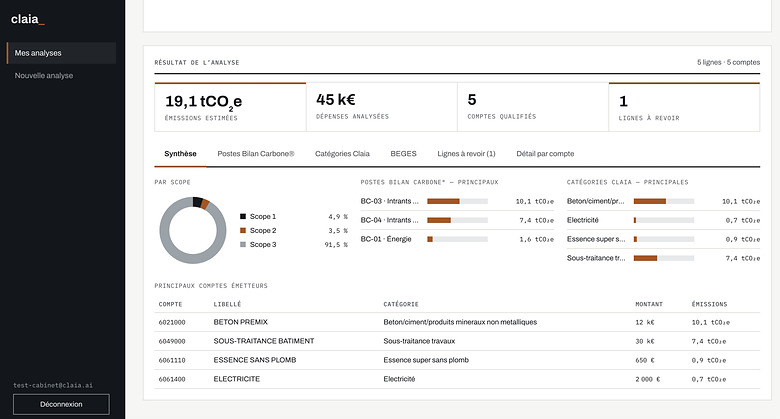
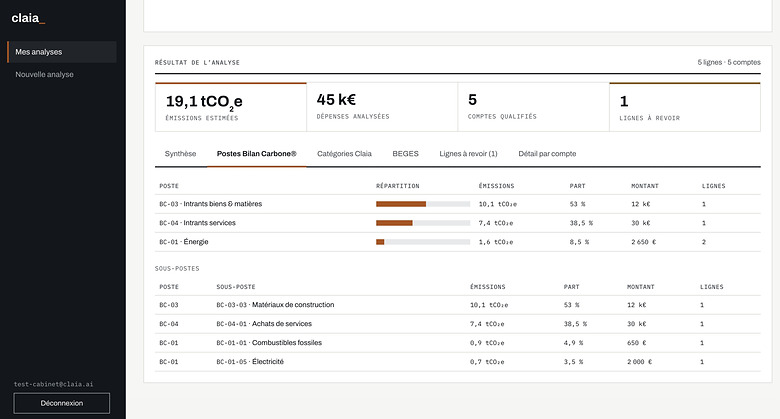
Lines categorised by emission source, suppliers identified, emissions computed, activity data extracted.
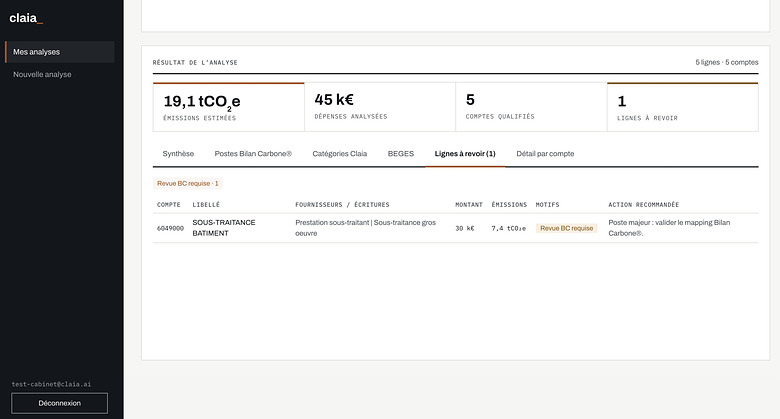
You review the classifications, make the calls and export to your own Excel template. Corrections in the workbook update the calculations.
Three tools, one workflow.
Claia analyses your client’s general ledger and fixed-asset register: expenses categorised by emission source, exclusions documented, emissions computed. The cases that skew assessments are handled: VAT according to the entity’s regime, depreciation cross-checked against purchases, equipment subsidies set aside to avoid double counting.
When the account alone is not enough, Claia identifies the supplier and its actual activity to refine both the category and the emission factor. An ENGIE contract can mix gas and electricity: lines are split from their labels, and the factor follows the energy actually invoiced.
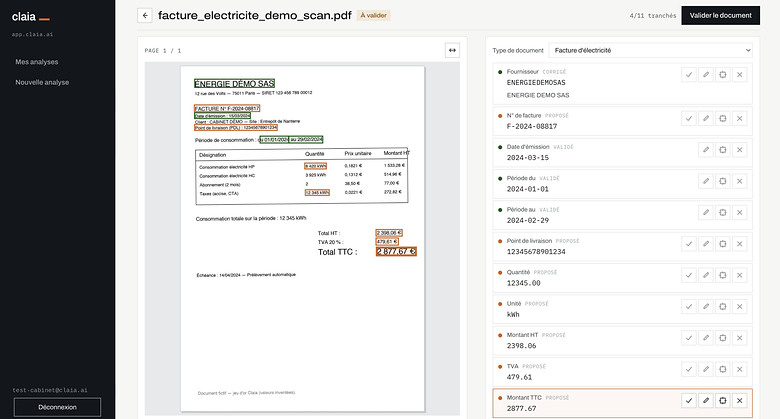
You choose which documents to analyse and the level of precision you need. Claia reads invoices and documents to progressively replace spend-based estimates with real activity data: kWh, litres, tonnes or tonne-kilometres. An invoice turns an estimate into a measured value, with the method and confidence level clearly identified. Commuting and freight distances are computed from the addresses and routes provided.
Claia analyses your client’s general ledger and fixed-asset register: expenses categorised by emission source, exclusions documented, emissions computed. The cases that skew assessments are handled: VAT according to the entity’s regime, depreciation cross-checked against purchases, equipment subsidies set aside to avoid double counting.
When the account alone is not enough, Claia identifies the supplier and its actual activity to refine both the category and the emission factor. An ENGIE contract can mix gas and electricity: lines are split from their labels, and the factor follows the energy actually invoiced.
You choose which documents to analyse and the level of precision you need. Claia reads invoices and documents to progressively replace spend-based estimates with real activity data: kWh, litres, tonnes or tonne-kilometres. An invoice turns an estimate into a measured value, with the method and confidence level clearly identified. Commuting and freight distances are computed from the addresses and routes provided.
Calibrated on French data, ready to travel.
Claia is calibrated on French accounting data: statutory exports, public-sector ledgers, the ADEME Base Carbone® emission-factor database, supplier identification through the official French registries (SIRENE, INPI). The chart of accounts and the factor database are pluggable. Working with another country’s data? Get in touch and we will look at your case together.
Proven on real engagements.

Every engagement was carried out with members of the ABC (Association pour la transition Bas Carbone), the French non-profit that owns and maintains the Bilan Carbone® method, France’s reference GHG accounting framework, compatible with the GHG Protocol and ISO 14064.
About ten public entities processed for a Bilan Carbone® consultancy: multi-budget ledgers, fixed-asset registers, VAT regimes settled entity by entity. 93% agreement on the first blind pass. Delivered in the firm’s own template, under its brand.
Five French non-profits supported by Mouvement Tilt, a network helping associations decarbonise: accounting exports analysed, emission categories ranked, a targeted document collection prepared.
A pilot for a construction client: ledger analysed, commuting and freight data extracted from questionnaires and PDF documents, distances and durations computed automatically.
You stay the expert.
You keep control of the assumptions, the data collection, the emission factors and the final analysis. You keep your tools, your templates and your way of working. Claia does not produce the assessment in your place.
A process you can audit.
Built with the people who use it.
Claia was born from a simple observation: a large share of carbon professionals’ time still goes into turning heterogeneous accounting files into usable data. Claia prepares that data and leaves interpretation and action to the expert. The product is built with the consultancies that run these assessments, on their real cases. Claia was born at Station F (Paris).

Software engineer, several years spent on complex document data in fields where traceability and reliability are critical.
A conversation, a demo on a real case, or a first pass on one of your own files. English or French, as you prefer.